

Kizuna Solutions: Good Practice with Japanese Companies
2026.1
JFE Engineering in Viet Namⅰ
– Total Project Development of Waste-to-Energy (WtE) –ⅱ
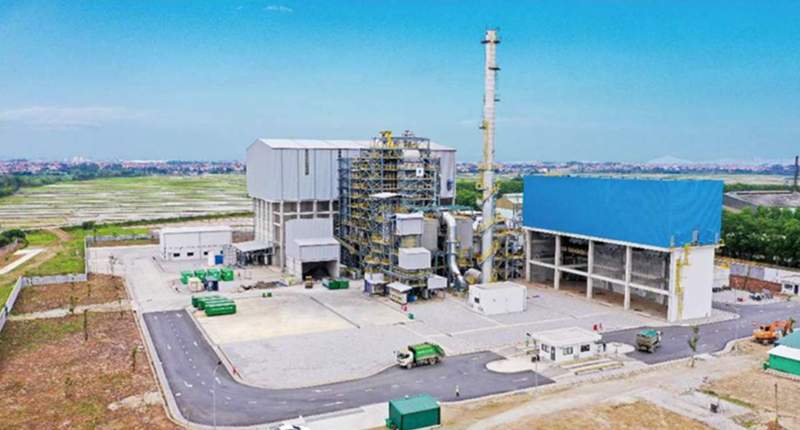
| Summary | In Viet Nam, rapid economic growth and population increases have led to a sharp rise in waste generation. Urban areas face particularly acute challenges as accelerating population inflows have driven municipal waste volumes even higher, placing severe pressure on existing waste treatment infrastructure. To help address these social challenges in Bac Ninh Province, JFE Engineering Corporation (JFEE) delivered the complete project lifecycle by working together with local partners and communities: covering planning, financing, construction and operation. |
|---|---|
| Reference | Participating in a Large-Scale Waste to Energy Project in Vietnam Total produce from business planning to construction and operation Waste to Energy Project in Bac Ninh Province (JCM) |
Waste Management Challenges in Viet Nam
Since 2000, Viet Nam has experienced rapid urbanization, with populations increasingly concentrated in urban areas. This trend is expected to continue steadily through 2050. As urbanization accelerates, the volume of waste generated in municipalities has risen sharply, making proper waste management a major social challenge.
In 2020, the Vietnamese government updated its Nationally Determined Contribution (NDC), setting a target to reduce CO₂ emissions by 9% from the business-as-usual (BAU) scenario by 2030. Coal remains the country’s largest source of emissions, and to achieve its reduction targets, the government is considering measures such as phasing out coal subsidies and introducing coal taxes. In addition, a government resolution requires municipalities to manage their greenhouse gas (GHG) emissions in line with national emission levels (Government Resolution No. 122).
Against this background, demand is growing rapidly for advanced waste treatment technologies and for alternatives to fossil fuels. In particular, Waste-to-Energy (WtE) projects have gained momentum in recent years, supported by a range of incentives and preferential measures introduced by the Vietnamese government, creating a highly favorable policy environment for their development.
Solutions by JFEE
Blueprint
Based on the population of the waste collection area, the required processing capacity was calculated, and a plant capable of incinerating 500 tons per day of municipal and industrial waste was introduced. The facility has a power generation capacity of 11.6 MW and an annual electricity output of 91,872 MWh, achieving high combustion and power generation efficiency. In operation, the facility significantly enhances Viet Nam’s waste treatment capacity and is expected to reduce GHG emissions by approximately 600,000 tons over a 15-year period. The project also reduces CO₂ emissions compared with fossil fuel-based power generation, while providing a stable supply of energy.
JFEE’s extensive experience as both a plant engineering and a waste management company enabled high facility availability. The combination of construction and O&M experience proved critically important.
For further technical details, please visit:
https://gec.jp/jcm/projects/21pro_vnm_01/
The Road to Launch
Business Profitability Model
The revenue structure of the WtE project consists of two primary income streams: electricity sales revenue and waste treatment fees.
Electricity sales revenue is generated through Viet Nam’s Feed-in Tariff (FIT) scheme, under which the Vietnamese government guarantees to purchase electricity from specific power generation projects at a predetermined fixed price. The contract term is 20 years, and the buyer is Vietnam Electricity Group. Waste treatment fees include payments from the municipality for processing municipal waste, as well as fees from Thuan Thanh Company for handling industrial waste collected from nearby factories. The facility receives 350 tons per day from the municipality and 150 tons per day from factories.
In Viet Nam, municipal waste treatment fees are relatively low, and relying solely on municipal waste would not ensure profitability. To establish a viable business model, the project accepts industrial waste, which carries higher processing fees, and combines waste treatment with power generation to secure economic sustainability.
Building Relationships with Local Partners
Waste management requires coordinated efforts throughout the complete project lifecycle, including budgets, systems, transport, treatment facilities, and awareness among both authorities and citizens, making an integrated strategy essential. Moreover, Viet Nam’s national master plan specifies where and how waste must be treated, meaning the project had to align with these requirements. As one of the country’s first WtE initiatives, both JFEE and Bac Ninh authorities faced a difficult approval process due to limited prior experience.
A knowledgeable local partner was also crucial for tasks such as waste collection and permitting. Although JFEE approached many state-owned and private firms, few showed interest, as the concept of proper waste treatment was not yet widespread. A turning point, however, came at the Ministry of the Environment, Japan’s “Environment Week” in Hanoi in 2018, where JFEE was connected with Thuan Thanh Environment Joint Stock Company, which was already engaged in waste incineration and recycling businesses.
To build the partnership, Thuan Thanh representatives visited Japan to observe JFEE’s municipal waste plants and J&T Recycling Corporation’sⅲ facilities, which gave them confidence in JFEE’s expertise not only in construction but also in Operation and Maintenance (O&M), particularly in handling industrial waste.
 |
|---|
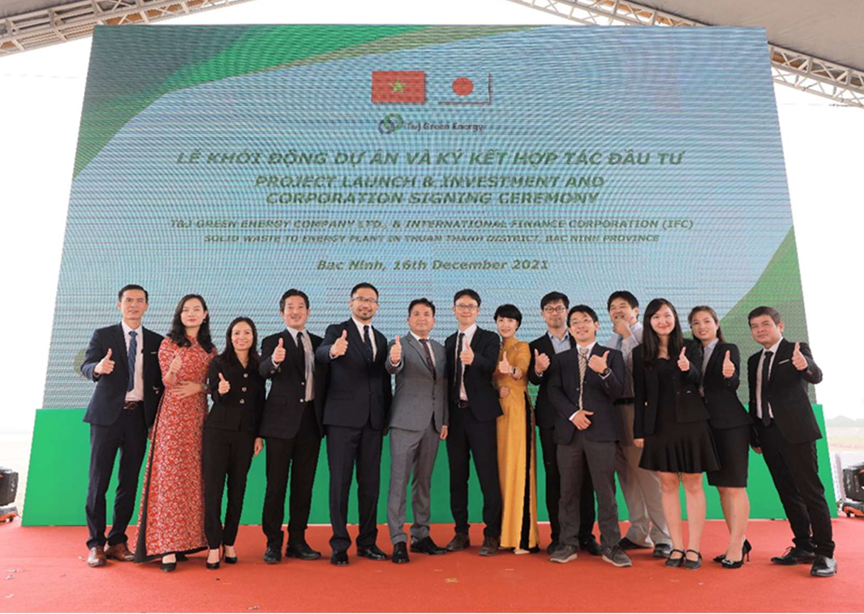
Project Launching Ceremony |
Financing
Arrangements such as waste treatment contracts and Power Purchase Agreements (PPAs) in Viet Nam have not yet reached a level sufficient for full project financing. During the project development, securing bank financing turned out extremely difficult without a clear path forward. In the course of negotiations with various financial institutions, the International Finance Corporation (IFC) introduced Finland’s climate fund to JFEE. The Finnish Climate Fund assumed the financing risk for Thuan Thanh, enabling the IFC loan to proceed and finally securing the funding.
Relationships with Local Communities
As part of the IFC financing, the project has put strong emphasis on environmental and social responsibility by engaging independent third-party organizations to conduct an Environmental and Social Impact Assessment (ESIA) and establish robust monitoring systems.
Beyond these formal requirements, the project team continues to engage closely with local communities, including holding outreach classes at nearby primary schools and visiting surrounding villages to listen to residents’ concerns and ensure that the project is not causing adverse environmental impacts.
Highlights
Construction contracts for waste treatment facilities were typically structured so that the contractor constructs the facilities, hands them over once performance requirements are met, and the engagement ends there.
JFEE, however, is a unique company in the plant engineering sector, operating in two distinct roles: as a constructor of WtE plants and as a waste management operator. For this project, based on accumulated experience in constructing and operating waste management plants, JFEE was able to comprehensively implement all steps of waste management projects, from planning and construction to operation.
Looking Ahead
WtE is a technology that not only makes effective use of waste, but also helps curb fossil fuel use, cut GHG emissions, and reduce the burden on landfills. By safely processing waste while protecting the environment, we can treat waste as a valuable resource and energy source; boosting resource productivity and contributing to sustainable resource use.
At JFEE, our mission is simple: “Just For the Earth.” We do not just deliver infrastructure, we refine every detail: the right contract models, plant specifications, and operational methods. That way, we do not just “create”, we operate. JFEE provides infrastructure that supports communities in regions facing social challenges, long after the construction is done.
 |
|---|
|
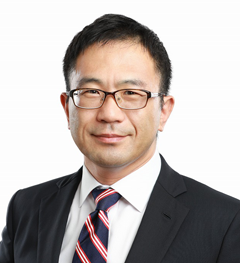
Speaker Introduction Mr. OHARA Takanobu |
|---|
- This document has been prepared based on information deemed reliable by JPRSI. No guarantee is made as to its accuracy or completeness.
- Any profit or loss resulting from actions taken based on this document is the sole responsibility of the party taking such actions, and JPRSI shall not be held liable.
- You are free to link to this document. If you quote or cite any part of this document by other means, please clearly state "JPRSI (Japan Platform for Sustainable Infrastructure) website" as the source.
ⅰ This article is prepared by JFE Engineering Corp. with its permission.
ⅱ The Waste-to-Energy plant at Bac Ninh Province, Viet Nam